
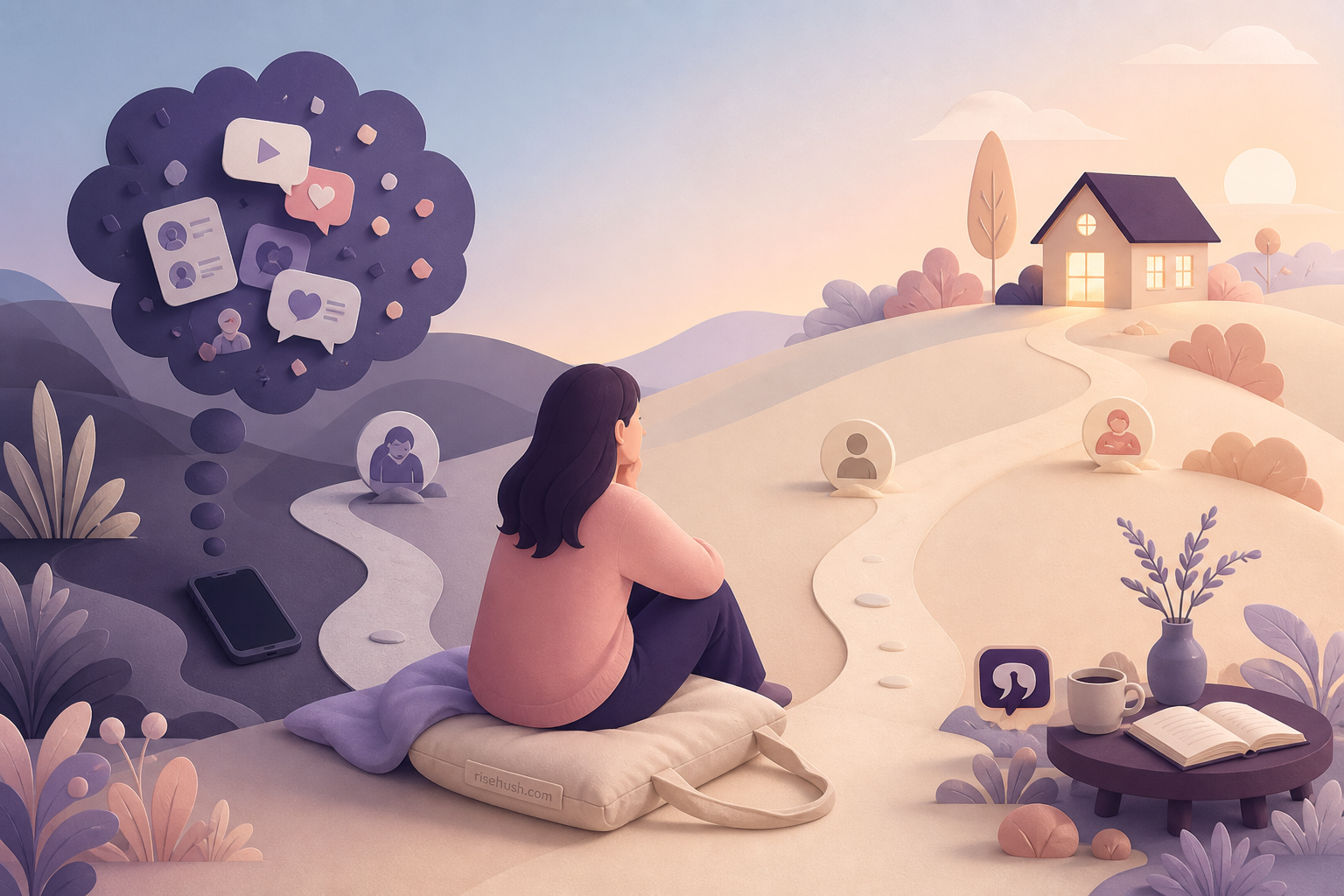
Three different evenings, one word people confuse
People say they need alone time, then spend the hour inside an infinite feed — and wonder why they feel neither rested nor connected. The research literature separates three states that ordinary language collapses. Solitude is time alone, which can be chosen and regulating. Loneliness is the painful perception of social isolation — which can happen in a crowd, and which is not the same as being alone. Screen-saturated aloneness is a third thing: a body in a quiet room and a mind in a noisy stream, often right before sleep.
Those distinctions are not word games. They change what you should try. If the evening problem is loneliness, more solitude will not reliably help. If the problem is over-arousal and unfinished cognitive loops, a chosen hour alone without a feed may. If the problem is sleep, the light and the after-lights-out phone habits matter whether or not you feel lonely at all.
This essay walks the evidence in that order. First solitude as affective self-regulation. Then loneliness as a different mechanism. Then media multitasking and the filtering cost of living in multiple streams. Then evening light and bedtime phone use. Then the careful nuance from large screen-time analyses — so the argument does not overclaim. It closes with a wind-down protocol assembled from those mechanisms, and with an honest account of where RiseHush fits: a finite, verified feed as an alternative to infinite scroll, not a cure for loneliness.
Every numbered claim is cited at the end. Nothing here treats “touch grass” as a study.
Solitude that regulates — when alone is not lonely
In a series of experiments published in Personality and Social Psychology Bulletin, Thuy-vy Nguyen, Richard Ryan, and Edward Deci tested solitude as an approach to affective self-regulation. Time alone generally produced a deactivation effect: high-arousal positive and negative affects both decreased. The effect appeared when people were alone, not when they were with someone else. It did not depend on whether they were reading. When people actively chose solitude, they reported more relaxation and less stress.
That finding reframes the evening. Chosen solitude is not a punishment or a productivity hack. It is a downshift: the nervous system’s volume knob turning lower. It also explains why “alone with the phone” so often fails as rest. If the feed keeps high-arousal content arriving — outrage, comparison, unfinished news — you are alone in body and stimulated in mind. The solitude effect Nguyen’s team measured assumes an alone that is actually alone.
Sherry Turkle’s MIT work on technology, intimacy, and solitude is best known from books and public essays; the peer-reviewed record includes a short 2011 reflection in Continuing Higher Education Review on how tethered connectivity reinvents intimacy and solitude. Treat it carefully: it is a research-informed essay, not a randomised trial. Its useful pressure matches the laboratory more than the self-help shelf: if you never practice being alone without a device, you may only know how to be lonely — a claim about capacity, not a diagnosis.
“Loneliness is not simply being alone.”
Louise C. Hawkley & John T. Cacioppo · Annals of Behavioral Medicine, 2010
Loneliness is not solitude
Louise Hawkley and John Cacioppo’s review in Annals of Behavioural Medicine is blunt: loneliness is the perception of social isolation, not the census of people in the room. It heightens vigilance for social threat, alters attention and memory in confirmatory ways, and is linked to poorer sleep and long-run health risk. Interventions that merely increase contact without addressing those biases often disappoint.
Read beside Nguyen, the evening advice splits cleanly. If you feel lonely, the first move is reconnection — or cognitive work on the loneliness loop — not a heroic digital detox that leaves you alone with threat-focused rumination. If you feel overstimulated and fragmented after a day of inputs, chosen solitude without a feed may be the regulating move. Our companion essay on the science of loneliness walks the first path in more depth. This one stays with the second: protecting restorative alone time from the streams that cancel it.
Doomscrolling sits awkwardly between the two. It can be an attempt to soothe loneliness with simulated sociality, and it can also be an arousal machine that delays sleep. Either way, it is a poor substitute for either genuine connection or genuine solitude.

 risehush.com
The multitasking mind that cannot filter
Before bedtime, many people do not merely “check” a phone. They inhabit several media at once: messages, headlines, video, email residue. In 2009, Eyal Ophir, Clifford Nass, and Anthony Wagner at Stanford published a PNAS paper comparing heavy and light media multitaskers on cognitive-control tasks. Heavy multitaskers were more susceptible to interference from irrelevant environmental stimuli and from irrelevant representations in memory — and, surprisingly, performed worse on a task-switching test, likely because they struggled to filter out the irrelevant task set.
The popular retelling sometimes overreaches; later work has nuanced parts of this literature, and our essay on focus in a distracted world already walks the interruption and attention-residue evidence with that caution. The durable Stanford claim is still enough for an evening design decision: chronic practice at juggling streams is associated with a breadth bias that lets irrelevant information in. An infinite feed is engineered for exactly that bias. A finite one is not.
Solitude with six apps open is not solitude in Nguyen’s sense. It is media multitasking performed alone.
Light, phones after lights out, and the morning you borrow from
Sleep is where the screen argument becomes physiological. At Brigham and Women’s Hospital and Harvard Medical School, Anne-Marie Chang, Daniel Aeschbach, Jeanne Duffy, and Charles Czeisler compared reading a light-emitting eReader with reading a printed book in the hours before bed. The LE-eBook condition delayed sleep onset, reduced evening sleepiness and melatonin, shifted circadian timing later, and reduced next-morning alertness. Short-wavelength–enriched light is not a metaphor for “too much phone.” It is a signal to the biological clock.
The behavioural layer matches. In a Social Science & Medicine study of 844 Flemish adults, Liese Exelmans and Jan Van den Bulck found that sending or receiving texts or calls after lights out predicted worse Pittsburgh Sleep Quality Index scores — longer latency, worse efficiency, more disturbance, more daytime dysfunction — plus higher insomnia scores and more fatigue. Six in ten took the phone into the bedroom. The bedroom had become a second office and a second social square.
Those two papers together explain why “I’ll just wind down on my phone” so often fails. The content can raise arousal; the light can delay melatonin; the after-lights-out checking can fragment the night. Our companion essay on sleep and the racing mind takes the cognitive side further. Here the design lesson is simpler: treat the last forty-five minutes as a different room — dimmer, quieter, and preferably phoneless.
Try it now
Design a 45-minute wind-down
Pick up to three evening anchors. Phones last; light and language first. Small enough to keep on a weeknight. Your plan stays in this browser.
Screen time without the panic — and without the shrug
Honesty requires a brake on moral panic. Amy Orben and Andrew Przybylski applied specification-curve analysis across three large adolescent datasets (total N ≈ 355,358) and found that the association between digital technology use and well-being was negative but small — explaining at most about 0.4% of the variation in well-being. Effects that tiny do not licence sweeping claims that “screens destroy a generation,” and they do not licence policy theater built on uncontrolled correlational fishing.
They also do not licence a shrug about evening design. A small average association between total daily technology use and adolescent well-being is compatible with large, specific costs of light-emitting devices before bed, phones after lights out, and heavy media multitasking. Context, timing, and content matter more than a single daily-minutes number. The careful reading is: do not panic about every glance; do redesign the hour that owns tomorrow morning.
That nuance is why RiseHush’s product claim stays narrow. The problem we aim at is not “screens exist.” It is the infinite, unverified, arousal-first feed that colonizes solitude and sleep alike.
A quiet protocol for evenings that recover
Nothing above requires a cabin in the woods. Each finding adjusts a process: choose solitude when you need deactivation, treat loneliness as a different problem, stop multitasking your alone time, protect melatonin and sleep continuity, and keep screen advice timed and specific. Assembled strictly from those mechanisms, a weeknight looks like this:
- Decide which evening you are having. Lonely → reach for a person (see loneliness science). Overstimulated → chosen solitude without a feed. Tired but wired → wind-down before content.
- Dim early. Give the biological clock an hour of lower light. Chang’s eReader trial is the reminder that evening LE light is not free.
- Charge the phone outside the bedroom. Exelmans and Van den Bulck’s after-lights-out messaging predicted worse sleep quality and more fatigue.
- One stream, or none. If you read, prefer print or a single finite source. Heavy media multitasking tracks with poorer filtering — a bad match for rest.
- End with one true sentence, not a feed. A verified line is a closing cue; an infinite scroll is an opening of a thousand more. Pair with focus research if the day was interruptions all the way down.
Where RiseHush earns its keep
Most phone apps compete to become the evening. RiseHush was built to lose that competition on purpose. A finite, verified feed has an ending. Infinite scroll does not. That architectural difference is the product claim: when you want language in the last minutes of the day, you can have one well-set sentence — attributed, checked, done — instead of another hour borrowed from sleep and solitude.
RiseHush does not cure loneliness, treat insomnia, or replace social contact. It does not need your attention for an engagement metric. Reminder cues on Home Screen, Lock Screen, Watch, or a morning alarm can hold a true line where the day begins; the same finite ethic applies at night — one quote, then lights down. If the racing mind still will not settle, start with the wind-down tool above and the companion essay on sleep and the racing mind. If the ache is social rather than sensory, go to the science of loneliness instead of asking a quieter feed to be a friend.
Chosen solitude is a skill. Loneliness is a signal. Screens are tools that can serve either — or cancel both. The literature’s quieter instruction is design: protect the alone that regulates, repair the isolation that hurts, and stop letting an infinite stream pretend it is rest.
What is the difference between solitude and loneliness?
Solitude is time alone; Nguyen, Ryan, and Deci’s experiments show it can deactivate high-arousal emotion and, when chosen, support relaxation. Loneliness is the painful perception of social isolation — Hawkley and Cacioppo stress it is not simply being alone — and it can occur with or without company.
Is using my phone in bed really that bad for sleep?
Two separate mechanisms show up in peer-reviewed work: evening light-emitting screens can suppress melatonin and delay circadian timing (Chang et al.), and after-lights-out phone messaging predicts worse sleep quality and more fatigue in adults (Exelmans & Van den Bulck). Content and habit matter as much as the device.
Doesn’t research say screen time barely affects well-being?
Orben and Przybylski found the overall adolescent technology–well-being association is very small on average. That finding argues against blanket panic about total daily minutes — not against redesigning evening light, bedtime phone use, or infinite-scroll habits that specifically disrupt solitude and sleep.
Can solitude help if I feel lonely?
Usually that is the wrong lever. Loneliness calls for connection or work on the loneliness cognitive loop; forced isolation can worsen threat-focused vigilance. Chosen solitude helps more when the problem is over-arousal and fragmented attention than when the ache is social.
How is RiseHush different from just another evening app?
Infinite feeds are designed to continue. RiseHush is a finite, verified quote feed with optional reminders — one true sentence, then done. It is an attention cue for wind-down or morning ritual, not a social network, not a loneliness cure, and not medical treatment for insomnia.
- Nguyen, Ryan & Deci, Personality and Social Psychology Bulletin, 2018 — solitude produces affective deactivation (lower high-arousal positive and negative affect); chosen solitude linked to relaxation and reduced stress
- Turkle, Continuing Higher Education Review, 2011 — peer-reviewed reflection on how networked technology reinvents intimacy and solitude (“the tethered self”); cite as essayistic synthesis of her MIT research program, not as an RCT
- Hawkley & Cacioppo, Annals of Behavioural Medicine, 2010 — theoretical and empirical review: loneliness is perceived social isolation (not merely being alone); linked to threat vigilance, sleep disruption, and health risk via a self-reinforcing regulatory loop
- Ophir, Nass & Wagner (Stanford), PNAS, 2009 — heavy media multitaskers show greater susceptibility to interference from irrelevant stimuli and memories and worse task-switching performance, consistent with reduced filtering
- Chang, Aeschbach, Duffy & Czeisler, PNAS, 2015 — evening light-emitting eReader vs. print book: delayed sleep onset, reduced melatonin, later circadian timing, and reduced next-morning alertness
- Exelmans & Van den Bulck, Social Science & Medicine, 2016 — adults’ bedtime/after-lights-out mobile phone use predicted worse PSQI sleep quality, higher insomnia scores, and more fatigue (N=844)
- Orben & Przybylski, Nature Human Behaviour, 2019 — specification-curve analysis across three large adolescent datasets (N≈355,358): digital technology use–well-being association negative but small (≤0.4% variance) — nuance against both panic and complacency