
A quote is not a work plan
A motivational line can change the tone of a morning, but it cannot decide what the morning is for. The useful question is not “How do I feel more driven?” It is “What would this idea look like in the next twenty minutes?” That question keeps encouragement attached to an observable action.
Choose one line that names a value you actually want to practise: care, patience, courage, concentration, or honesty. Then remove the vague promise. “Be productive” is a mood request; “open the draft and write the first three sentences before checking messages” is a beginning.
Turn the line into an if–then plan
Implementation intentions link a cue to a response: if a particular situation appears, then a specified action begins. A meta-analysis of 94 independent tests found that these plans can help people translate intentions into goal-directed behaviour. The evidence does not make a quote powerful by itself; it shows why a quote becomes more useful when it ends in a concrete cue and response.
Try this format: “If I finish coffee, then I will put my phone on the other side of the room and work on the highest-friction task for ten minutes.” The time window is deliberately modest. A small start creates information about the task; it does not require you to pretend the task is easy.
Protect the attention the action needs
Motivation for work often fails at the boundary between intention and interruption. Decide in advance what will be unavailable for the first short block: email, social feeds, a noisy notification channel, or an open meeting list. The aim is not permanent focus. It is a protected experiment long enough to learn whether the chosen action can start.
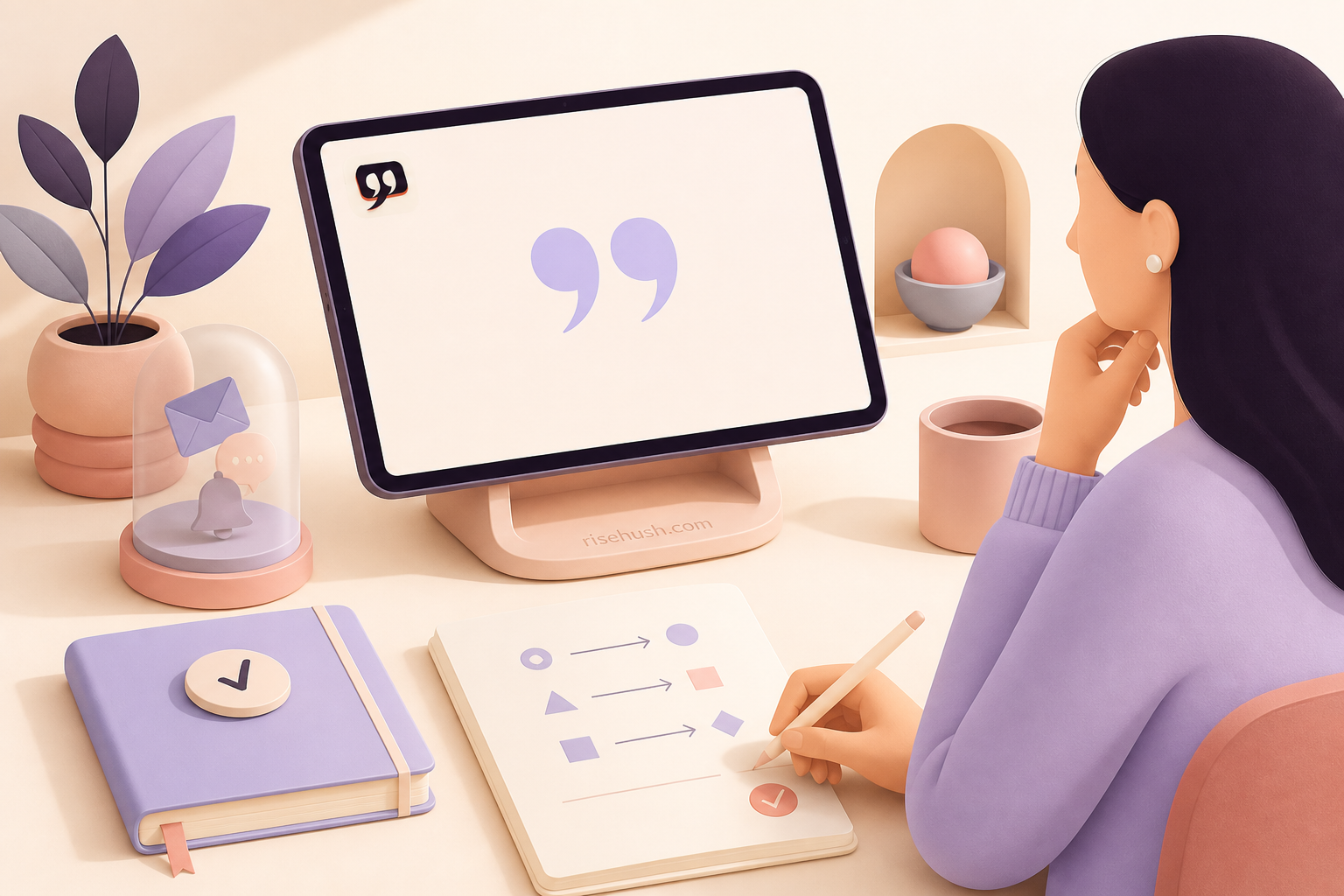
RiseHush can serve as a quiet cue through a reminder or widget, while the work itself stays outside the app. That boundary matters. A motivation product should help you return to the task, not become another place to endlessly browse. The research on protected attention makes the same distinction.
Review the evidence, not your character
At the end of the block, record what happened in one sentence: what started, what interrupted, and what the next adjustment should be. If the action was too large, shrink it. If the cue was unreliable, attach it to a more stable transition. If the work exposed a missing skill, name the skill instead of converting the gap into a verdict about yourself.
This is where a daily quote earns its keep. It becomes a short reminder of how you want to respond, while the review gives you something better than inspiration: evidence about the conditions under which you can act. Keep the line if it helps you return; change it if it only adds pressure.
A quiet workday routine
Read one source-aware line. Name the value it points toward. Write one if–then plan. Protect ten minutes for the first action. Review what actually happened. That is enough for a daily motivation ritual to be useful without turning the workday into a performance of optimism.
For a quote experience that keeps the author and source visible, explore the RiseHush source catalog and the canonical download route. The app can provide the cue; the next action remains yours.
What is the best daily motivation for work?
The best line is one that points to a value you can express in a specific next action. Pair it with an if–then plan and a short protected work block rather than treating the quote as a productivity guarantee.
Can motivational quotes improve productivity?
A quote alone is not a productivity intervention. It may act as a cue, but the evidence-backed part is the concrete plan, protected attention, and review of what happened.
How can I use RiseHush at work?
Use a daily quote, reminder, or widget as a cue before a chosen transition. Then put the device aside and attach the line to one small work action.