

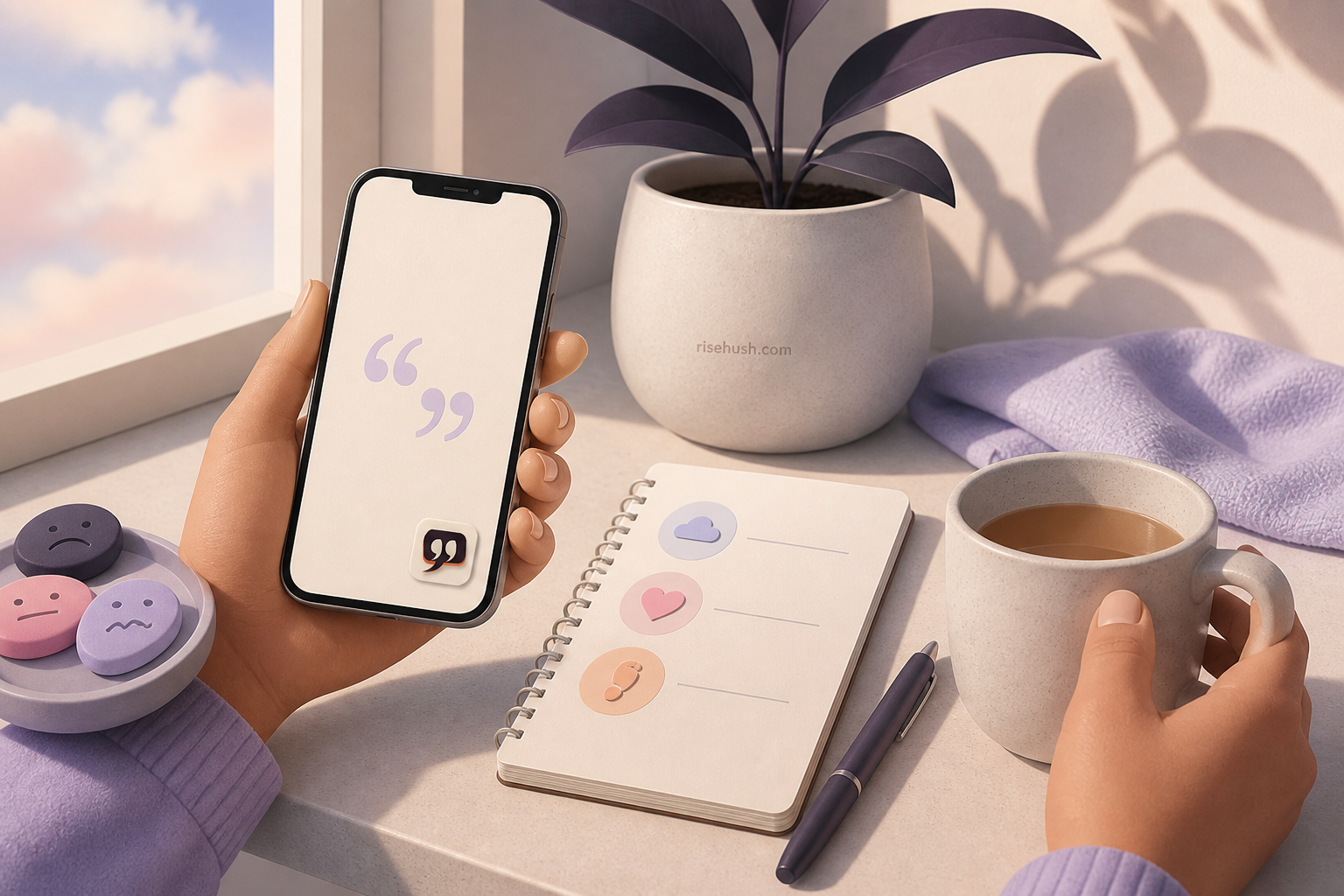
Positive thinking is not permanent cheerfulness
A positive mindset is often marketed as a mood you can install. Research uses narrower ideas: optimism, reappraisal, gratitude, self-compassion, hope, and the ability to identify a next action. These practices can coexist with grief, anger, fear, and uncertainty. The goal is not to force a pleasant emotion; it is to widen the set of responses available when the first response is not useful.
Meta-analytic evidence on optimism and gratitude suggests modest associations with mental health and well-being, while intervention research remains specific and bounded. That is good news, not a disappointment: a small practice can be worth trying without being sold as a cure. [8–10]
Compare the method behind the positivity
Ask whether the app invites observation, values, action, gratitude, or repetition. Ask whether it acknowledges limits. If every difficult thought is answered with a brighter sentence, the system may be training avoidance rather than flexibility. If the app helps you name the feeling, choose a value, and take one step, it is closer to a useful practice.
RiseHush’s source-aware quote model can support honest positivity: a line may offer perspective without denying the facts. The method page and research journal should remain clear that a quote app supports reflection and routine; it does not diagnose or treat a condition. [16, 19]
A better positive loop: reappraise, do not erase
When a stressful event arrives, try a three-part sentence: “This is difficult.” “This matters because…” “The next useful response is…” That is not a demand to call the event good. It is a way to keep the feeling and the possibility of action in the same frame. Research on stress reappraisal suggests that how people interpret arousal can influence coping, but the findings should not be turned into a promise that mindset overrides circumstances. [11]
RiseHush can put the third sentence in view. The quote is the cue; the user’s honest description and next action are the practice.
A positivity app should leave room for “not today”
A user should be able to skip, quiet, change the category, or read a line that feels accurate rather than artificially upbeat. The ability to stop is not a failure of positivity. It is part of agency.
If the app makes you feel ashamed for having a hard day, choose a different tool or a human conversation. RiseHush is strongest when it offers a sentence as an invitation, not a test.
Positive thinking is not permanent cheerfulness
A positive mindset is often marketed as a mood you can install. Research uses narrower ideas: optimism, reappraisal, gratitude, self-compassion, hope, and the ability to identify a next action. These practices can coexist with grief, anger, fear, and uncertainty. The goal is not to force a pleasant emotion; it is to widen the set of responses available when the first response is not useful.
Meta-analytic evidence on optimism and gratitude suggests modest associations with mental health and well-being, while intervention research remains specific and bounded. That is good news, not a disappointment: a small practice can be worth trying without being sold as a cure. [8–10]
A positive mindset is often marketed as a mood you can install. Research uses narrower ideas: optimism, reappraisal, gratitude, self-compassion, hope, and the ability to identify a next action. These practices can coexist with grief, anger, fear, and uncertainty. The goal is not to force a pleasant emotion; it is to widen the set of responses available when the first response is not useful.
A positivity app should leave room for “not today”
A user should be able to skip, quiet, change the category, or read a line that feels accurate rather than artificially upbeat. The ability to stop is not a failure of positivity. It is part of agency.
If the app makes you feel ashamed for having a hard day, choose a different tool or a human conversation. RiseHush is strongest when it offers a sentence as an invitation, not a test.
A user should be able to skip, quiet, change the category, or read a line that feels accurate rather than artificially upbeat. The ability to stop is not a failure of positivity. It is part of agency.
A positivity app should leave room for “not today” — limits
A user should be able to skip, quiet, change the category, or read a line that feels accurate rather than artificially upbeat. The ability to stop is not a failure of positivity. It is part of agency.
If the app makes you feel ashamed for having a hard day, choose a different tool or a human conversation. RiseHush is strongest when it offers a sentence as an invitation, not a test.
A user should be able to skip, quiet, change the category, or read a line that feels accurate rather than artificially upbeat. The ability to stop is not a failure of positivity. It is part of agency.
What is the best positive thinking app?
Choose by method and fit: optimism, gratitude, reflection, audio, habits, or source-aware quotes. Avoid products that promise to erase difficult feelings.
Can positive thinking make problems go away?
No. It can influence attention and response, but real problems may require practical, relational, organizational, or clinical action.
How does RiseHush avoid toxic positivity?
It emphasizes accurate, source-aware language, finite cues, evidence boundaries, and a next action rather than a demand to feel happy.
- Gollwitzer, P. M. (1999). Implementation intentions: Strong effects of simple plans. American Psychologist, 54(7), 493–503.
- Lally, P., van Jaarsveld, C. H. M., Potts, H. W. W., & Wardle, J. (2010). How are habits formed: Modelling habit formation in the real world. European Journal of Social Psychology, 40(6), 998–1009.
- Schutte, N. S., & Malouff, J. M. (2024). The simultaneous impact of interventions on optimism and depression: A meta-analysis. Mental Health Science, 2(3), e79.
- Kirca, A., Malouff, J. M., & Meynadier, J. (2023). The effect of expressed gratitude interventions on psychological wellbeing: A meta-analysis of randomised controlled studies. International Journal of Applied Positive Psychology, 8(1), 63–86.
- Chen, S.-Y., Zhao, W.-W., Cheng, Y., Bian, C., Yan, S.-R., & Zhang, Y.-H. (2025). Effects of positive psychological interventions on positive and negative emotions in depressed individuals: A systematic review and meta-analysis. Journal of Mental Health, 34(2), 196–206.
- Tsai, N., Hawkesworth, J., Dieffenbach, J., Hua, D., Eneva, E., & Gabrieli, J. (2024). Social good reappraisal as a novel and effective emotion regulation strategy. PLOS ONE, 19(6), e0305756.
- World Health Organization. (2022). WHO guidelines on mental health at work.
- Mayo Clinic Staff. (2023). Job burnout: How to spot it and take action.
- RiseHush. (n.d.). Motivation app, method, and product boundaries.
- RiseHush. (n.d.). Research method and evidence boundaries.