
A quote in Messages becomes a social act
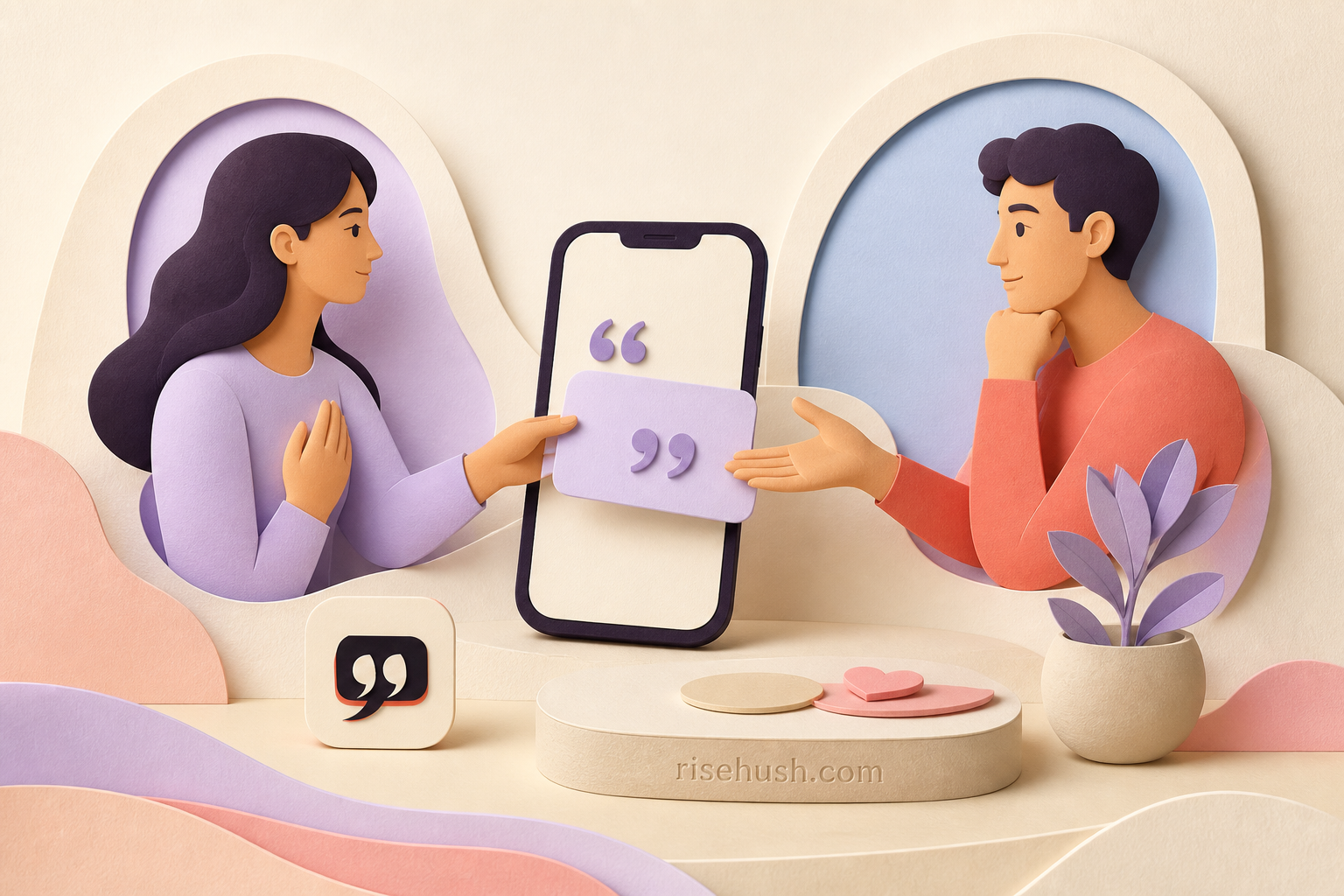
A quote read privately is a prompt. A quote sent in iMessage is a relationship move. It can say “I thought of you,” “I believe you can get through this,” or, less helpfully, “Here is a slogan instead of listening.” The correct design for a message surface is therefore smaller, more specific, and more relational than a feed.
Apple’s developer documentation says iMessage apps and extensions can let people share content and interact within a conversation, and Apple’s Human Interface Guidelines recommend one primary, immediately understandable experience. That is a strong constraint for a motivation product: the message should help the conversation, not interrupt it. [3]
The RiseHush opportunity is a private, human-sized share
RiseHush can help a person move from a trusted line to a kind human message: read, verify, write the personal context, and send only if the relationship can receive it. Quote Studio can support a considered visual card, but the card should remain optional and should not turn a friend’s hard day into branded content.
The current product should only claim a dedicated iMessage app or extension when that build and App Store record support it. Apple’s framework makes the surface possible; product evidence decides whether RiseHush currently ships it. [3, 16]
Three better messages than “stay positive”
“I’m thinking of you. No pressure to answer.” “This line reminded me of the part of you that keeps showing up; I’m here if you want company.” “Would it help if I took one practical thing off your plate?” The quote, if included, should sit behind the care rather than replace it.
This is where motivation becomes relationship. The app provides language; the person provides attention, consent, and follow-through.
A quote in Messages becomes a social act
A quote read privately is a prompt. A quote sent in iMessage is a relationship move. It can say “I thought of you,” “I believe you can get through this,” or, less helpfully, “Here is a slogan instead of listening.” The correct design for a message surface is therefore smaller, more specific, and more relational than a feed.
Apple’s developer documentation says iMessage apps and extensions can let people share content and interact within a conversation, and Apple’s Human Interface Guidelines recommend one primary, immediately understandable experience. That is a strong constraint for a motivation product: the message should help the conversation, not interrupt it. [3]
A quote read privately is a prompt. A quote sent in iMessage is a relationship move. It can say “I thought of you,” “I believe you can get through this,” or, less helpfully, “Here is a slogan instead of listening.” The correct design for a message surface is therefore smaller, more specific, and more relational than a feed.
Three better messages than “stay positive”
“I’m thinking of you. No pressure to answer.” “This line reminded me of the part of you that keeps showing up; I’m here if you want company.” “Would it help if I took one practical thing off your plate?” The quote, if included, should sit behind the care rather than replace it.
This is where motivation becomes relationship. The app provides language; the person provides attention, consent, and follow-through.
“I’m thinking of you. No pressure to answer.” “This line reminded me of the part of you that keeps showing up; I’m here if you want company.” “Would it help if I took one practical thing off your plate?” The quote, if included, should sit behind the care rather than replace it.
Three better messages than “stay positive” — limits
“I’m thinking of you. No pressure to answer.” “This line reminded me of the part of you that keeps showing up; I’m here if you want company.” “Would it help if I took one practical thing off your plate?” The quote, if included, should sit behind the care rather than replace it.
This is where motivation becomes relationship. The app provides language; the person provides attention, consent, and follow-through.
“I’m thinking of you. No pressure to answer.” “This line reminded me of the part of you that keeps showing up; I’m here if you want company.” “Would it help if I took one practical thing off your plate?” The quote, if included, should sit behind the care rather than replace it.
Can I send a motivational quote through iMessage?
You can share a quote through Messages if the app and platform support the action. Check the current build, then add personal context and verify the attribution.
Is a motivational quote helpful when a friend is struggling?
Sometimes, if it fits the person and follows listening. Do not use it to dismiss grief, illness, conflict, or a request for practical help.
Does RiseHush have an iMessage app?
Only claim a dedicated iMessage extension when the current release and App Store record verify it. RiseHush can still support careful sharing through source-aware quote and card workflows.
- Apple. (n.d.). iMessage apps and stickers. Apple Developer.
- Gollwitzer, P. M. (1999). Implementation intentions: Strong effects of simple plans. American Psychologist, 54(7), 493–503.
- Lally, P., van Jaarsveld, C. H. M., Potts, H. W. W., & Wardle, J. (2010). How are habits formed: Modelling habit formation in the real world. European Journal of Social Psychology, 40(6), 998–1009.
- World Health Organization. (2022). WHO guidelines on mental health at work.
- Gu, Y., Ocampo, J. M., Algoe, S. B., & Oveis, C. (2022). Gratitude expressions improve teammates’ cardiovascular stress responses. Journal of Experimental Psychology: General, 151(12), 3281–3291.
- RiseHush. (n.d.). Motivation app, method, and product boundaries.
- RiseHush. (n.d.). Quote source index.
- RiseHush. (n.d.). Correctly Credited: quotation corrections and attribution notes.
- RiseHush. (n.d.). Research method and evidence boundaries.