
The short answer: the best motivation app creates a useful moment, then gets out of the way
Motivation is not a permanent mood, and a quote is not a treatment. A well-designed app can still do something valuable: place a carefully chosen idea in front of you at a moment when it can support attention, perspective, gratitude, or one next action. The quality of that moment depends less on the size of the quote library than on content integrity, timing, friction, privacy, and whether the practice transfers into life away from the screen.
The market has split into recognizable jobs. Motivation and Inspire make short quotations easy to receive, personalize, and share. Calm, Headspace, Insight Timer, and Medito lead with meditation, sleep, and audio. Streaks and Fabulous focus on routines. Stoic and Day One make reflection more durable. Apple Journal sets a private, device-native baseline. These products are not identical competitors; they are different answers to the same human question: what would help me take the next constructive step today?
RiseHush occupies a useful space between those categories. Its promise is not that a sentence will fix a difficult life. It is that one source-aware line, presented with restraint, can become a small ritual: read, understand, choose a next action, and return to the people and work that matter.
The 2026 market: four jobs, many surfaces, and a clear opening for curation
A market comparison is more useful when it compares jobs rather than pretending every app belongs on one universal leaderboard. In the current Apple ecosystem, four patterns recur: ambient encouragement, guided regulation, habit formation, and reflective meaning-making. A person may use more than one. The strategic question for RiseHush is where a source-aware quote ritual adds value that a large audio library, a streak counter, or a full journal does not already provide.
Motivation by Monkey Taps demonstrates the scale of quote-led demand, with categories, themes, reminders, widgets, sharing, Apple Watch, Apple TV, and iMessage listed in its public App Store record. Calm demonstrates the breadth of a subscription wellness platform across multiple Apple surfaces. Stoic shows how a reflection product can combine Apple devices, iMessage, Siri Shortcuts, Health, and iCloud. Streaks demonstrates that a focused, paid utility can be compelling without becoming a content feed. Each competitor’s storefront record should be checked independently because device support and entitlements change.
Those products deserve credit for making daily support accessible. Their differences also reveal an opening: a calm, adult, editorially accountable product that does not ask the user to consume endlessly, gamify every lapse, or confuse encouragement with clinical care. RiseHush can compete by making the quality of one moment visible.
| User job | Common market response | A better design question |
|---|---|---|
| I need a brief cue | Quote, affirmation, reminder, or widget | Can I read it without opening an endless feed? |
| I need to regulate stress | Breathing, meditation, sleep audio, or a timer | Does the product set an honest boundary around what it can help with? |
| I want to repeat a behavior | Streaks, routines, goals, or coaching | Does a missed day teach me something instead of creating shame? |
| I want meaning and context | Journal prompts, mood logs, source notes, or reflection | Can I understand the idea and carry it into a real conversation or task? |
Apple ecosystem design: each device should have one honest role
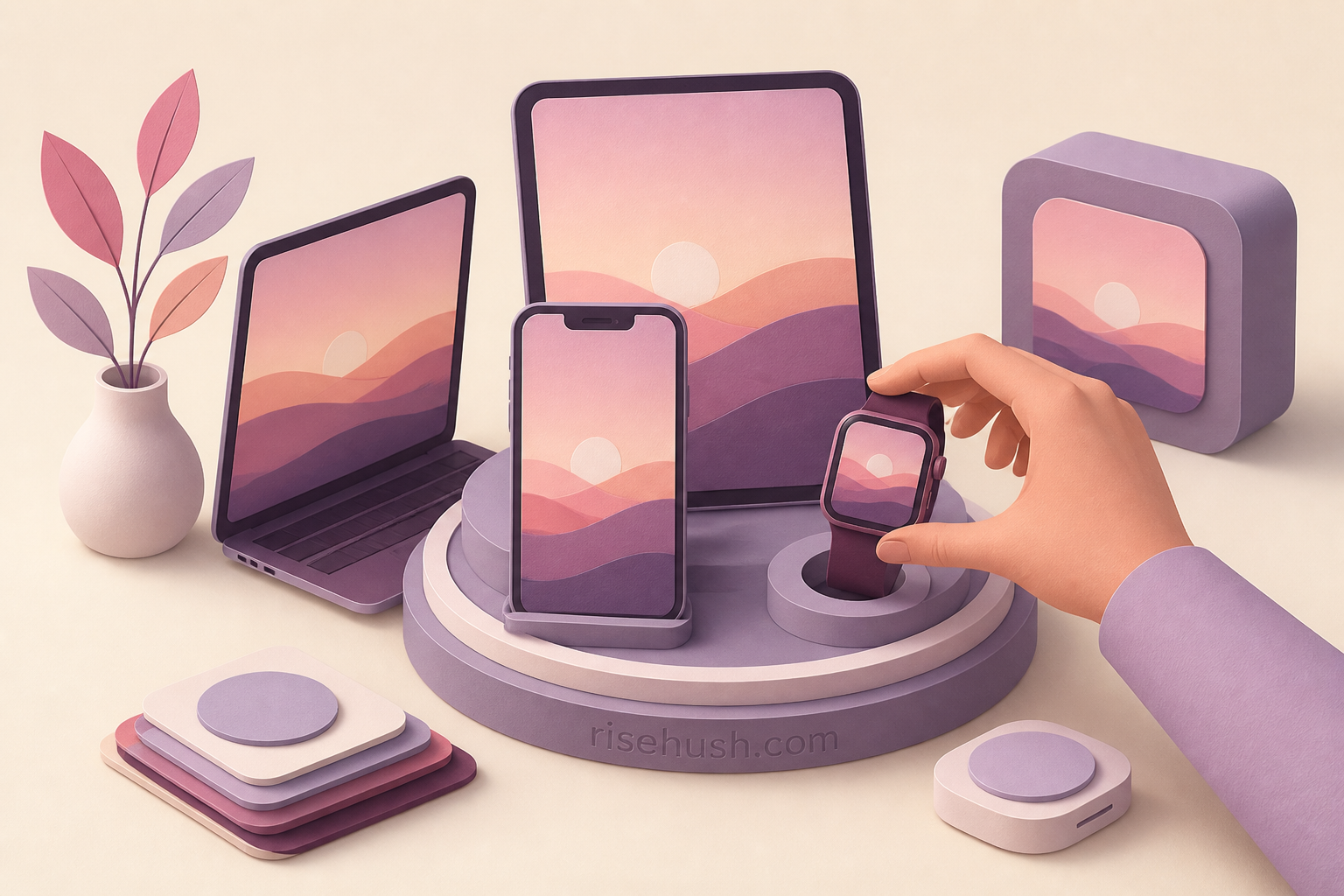
A motivation app does not become excellent by repeating the same screen on six devices. The Apple ecosystem is valuable when each surface is fitted to the time and attention available there. iPhone and iPad can hold the full ritual and source context. Mac can provide a quiet menu-bar or desktop return point while a person works. Apple Watch can offer a glance and a single completion action. Apple TV can create an ambient shared space. visionOS can make room for a spatial pause. Widgets can keep one line present without demanding a feed session.
Siri and Shortcuts are especially important because they turn an app from a destination into a small capability. Apple's App Intents framework is designed to expose actions to Siri, Spotlight, Shortcuts, widgets, Focus, and system experiences. For a motivation product, the useful actions are deliberately small: show today's line, start a sixty-second reset, save a quote, mark an intention complete, or open a chosen reflection. The point is not automation for its own sake; it is reducing the gap between intention and action.
iMessage is a distinct category. Motivation and Inspire use it for shareable encouragement, and Stoic lists iMessage as part of its broader reflection ecosystem. Sharing can strengthen a relationship when it is consent-based and personal, but it can also turn vulnerable moments into social performance. RiseHush should treat iMessage as an opportunity for a private, two-person gesture only when the current build and public storefront evidence support the feature. Until then, the responsible editorial claim is about the market pattern, not an invented RiseHush capability.
 risehush.com
What the evidence supports: small, voluntary practices with realistic expectations
Positive psychology is not a command to feel cheerful. It is a research program concerned with strengths, meaning, relationships, and conditions that support human flourishing. The strongest lesson for product design is modest: brief practices can produce small benefits for some people, but effects vary by intervention, outcome, population, and context. A product should therefore invite a practice, show its limits, and leave room for the user's actual experience.
Recent syntheses are encouraging without being magical. A 2024 meta-analysis found that optimism interventions improved optimism and reduced depressive symptoms, while also reporting substantial heterogeneity. A 2023 meta-analysis of expressed-gratitude interventions found a small improvement in psychological wellbeing. A 2025 meta-analysis in depressed populations found outcome-specific benefits from positive psychological interventions, with effects varying across measures. These findings support offering a brief reflective cue; they do not support promising that an app can cure depression, anxiety, trauma, or burnout.
The 2024 JAMA Psychiatry study of 49,275 older women found that higher gratitude was associated with a 9% lower risk of death over the follow-up period. That is a noteworthy association, not proof that a gratitude reminder extends life. The sample was specific, the design was observational, and the result cannot be converted into a product guarantee. Good editorial work preserves both the hopeful signal and the uncertainty.
| Practice | What the literature suggests | How RiseHush should frame it |
|---|---|---|
| Gratitude | Small average wellbeing benefits, with low-certainty and heterogeneous evidence | Notice one specific good and, when appropriate, thank a person; do not deny pain |
| Optimism | Interventions can improve optimistic expectations and mood outcomes | Pair hope with a plan and reality checks, not slogans |
| Reappraisal | Distancing and social-good reappraisal can reduce short-term negative emotion | Create perspective without suppressing danger, grief, or justified anger |
| Positive psychology | Some interventions help some outcomes, especially when matched to context | Offer a small voluntary exercise, not a promise of transformation |
From quote to action: motivation becomes more durable when it names the next step
A sentence can change attention without changing behavior. The bridge is a concrete action that is small enough to perform in the real context where the cue appears. Gollwitzer's work on implementation intentions distinguishes a general goal from an if-then plan: when a specific situation occurs, I will take a specific response. That structure is a better product pattern than a generic instruction to try harder.
Habit research reinforces the same humility. Lally and colleagues found that automaticity develops over a wide range of times rather than a fixed twenty-one days. A 2024 systematic review likewise found large variation in habit-formation time, with context stability and repetition helping but no universal deadline. A randomized walking study also cautioned that automaticity alone does not guarantee maintenance. The useful implication is not to abandon streaks; it is to design recovery, context, and a smaller version of the action.
A RiseHush ritual can be intentionally finite: one quote, one question, one if-then plan, and one invitation to stop. For example: if I open my laptop and feel the urge to avoid the difficult email, then I will write the subject line and one honest sentence before checking another tab. The quote supplies meaning; the plan supplies a handle; the work still belongs to the person.
 risehush.com
- Choose one context: morning, work, study, movement, relationship, or recovery.
- Read one source-aware line and name the feeling or situation it touches.
- Write one if-then action that can be completed in two minutes or less.
- Let the app close the loop by becoming quiet while the action happens.
- If the action is missed, reduce its size or change its cue instead of treating the lapse as a character verdict.
Friends, relationships, and work: positive change is social and structural
A positive mindset is not only an individual skill. Gratitude expressions can influence the person who receives them, and social connection is associated with health and wellbeing across the life course. The practical lesson is simple: a motivation app should sometimes point outward. A quote can become a thank-you message, a repair conversation, a request for help, or a decision to be present with a friend instead of continuing to scroll.
The same principle applies at work. An employee may benefit from a small cue before a difficult meeting, but an app cannot repair an unsafe workload, poor staffing, low autonomy, or an unfair manager. WHO guidance on mental health at work emphasizes organizational interventions, manager training, worker training, and return-to-work support. A 2023 meta-analysis found a small reduction in exhaustion from organizational interventions, with low certainty and substantial variation. A responsible product supports agency without relocating a structural problem entirely into the individual's mindset.
RiseHush can help at the human scale: a line that helps someone pause before replying, a reminder to thank a collaborator, a study cue that makes the first ten minutes easier, or a quote that helps a person ask for support. Its value is as a companion to real relationships and fair working conditions, not as a substitute for them.
The clinical boundary: encouragement is not treatment
A serious motivation product must say where it stops. WHO defines burnout as an occupational phenomenon resulting from chronic workplace stress that has not been successfully managed; it is not classified as a medical condition. Burnout can still overlap with depression, anxiety, sleep disorders, substance misuse, and other conditions that deserve professional assessment. A quote, a widget, or a streak is not a diagnostic tool.
Positive language can also become harmful when it invalidates a person's reality. Do not use gratitude to excuse abuse, optimism to hide discrimination, reappraisal to deny danger, or a streak to shame someone who is ill or exhausted. When a user is persistently unable to function, experiencing severe sleep disruption, using substances to cope, feeling hopeless, or thinking about self-harm, the right next step is qualified help and local emergency or crisis support - not more content.
This boundary makes RiseHush more trustworthy, not less ambitious. The product can help with a small moment of attention, reflection, or intention while respecting the complexity of a human life. The promise is narrow enough to keep.
How RiseHush helps: a quiet system for words that can travel into life
RiseHush is strongest when its features work as a connected system rather than as a checklist. The curated quote library reduces the cost of finding a meaningful line. The source catalog and Correctly Credited archive make attribution inspectable. The feed gives the sentence room to be read. Reminder planning helps a person choose a deliberate moment rather than accept a constant stream. Quote Studio turns a selected line into a personal visual artifact without requiring a public performance.
Across Apple surfaces, the product can meet different moments without changing its underlying promise. On iPhone and iPad, a person can read and reflect. On Apple Watch, the Quote of the Day can be a glanceable cue. On Mac, the experience can sit near work without becoming another noisy dashboard. On Apple TV and visionOS, the opportunity is ambient calm rather than a busy control panel. Widgets and system actions should remain optional, readable, and bounded. The public website's platform language should continue to follow verified storefront evidence as the product record is reconciled.
That is the positive case for downloading RiseHush: not that it will make every day easy, but that it gives a person a well-made place to begin. Choose a category. Read one line. Check the source when it matters. Turn it into a small action. Then close the app and continue with the day.
 risehush.com
A seven-day field test for choosing a motivation app
The best comparison is not the loudest ranking. It is a short, honest trial in the moments where you actually need support. Use the same test for RiseHush and any alternative. Keep one category, one delivery surface, and one small action so that you can evaluate the practice rather than the novelty of onboarding.
On day one, ask whether the app gives you a sentence you can read. On day two, inspect the author and the route to context. On day three, adjust reminders and quiet hours. On day four, test retrieval: can you find a saved line without friction? On day five, write an if-then action. On day six, read the privacy and data boundaries. On day seven, ask the decisive question: did the app help you return to your life, your work, your friend, or your body - or did it mainly help you return to the app?
That question is a useful market standard. A good motivation app earns trust through small, repeatable usefulness. RiseHush invites you to try that standard for yourself.
- Day 1: choose one theme and one delivery surface.
- Day 2: inspect attribution, source context, and readability.
- Day 3: set one deliberate reminder and quiet hours.
- Day 4: save a quote and test retrieval.
- Day 5: connect the line to one if-then action.
- Day 6: review privacy, optional network services, and account requirements.
- Day 7: measure what changed away from the screen, not only how often you opened the app.
What is the best motivation app for iPhone and Apple Watch?
There is no universal winner. Compare the job you need, content integrity, reminders, widgets, privacy, device coverage, and whether the app helps you take a small action. RiseHush is designed for a quiet, source-aware quote ritual across Apple surfaces.
Do positive mindset apps work?
Some brief positive-psychology, gratitude, optimism, and reappraisal interventions show small or moderate effects for some outcomes, but results vary. They are complements to life and professional care, not cures or guarantees.
How long does it take to build a habit?
Research shows wide individual variation rather than a fixed 21-day rule. Stable contexts, repetition, realistic actions, and recovery after lapses are more useful design principles than a universal deadline.
Can a motivation app treat burnout or depression?
No. A motivation app can offer a brief cue or reflection prompt, but persistent impairment, severe symptoms, or thoughts of self-harm require qualified professional help and local crisis support.
Why does RiseHush emphasize quote sources?
Because a beautiful sentence should not depend on a false attribution. RiseHush connects selected quotations to a visible source and correction practice, helping readers distinguish located passages, altered wording, and uncertainty.
- Apple. (n.d.). App Intents [Developer documentation]. Apple Developer. Retrieved August 11, 2026.
- Monkey Taps. (n.d.). Motivation - Daily quotes [Mobile app]. App Store. Retrieved August 11, 2026.
- Calm.com, Inc. (n.d.). Calm: Sleep, meditation, relaxation [Mobile app]. App Store. Retrieved August 11, 2026.
- Apple. (n.d.). Journal [Mobile app]. App Store. Retrieved August 11, 2026.
- Stoic app inc. (n.d.). Stoic: Journal & mental health [Mobile app]. App Store. Retrieved August 11, 2026.
- Crunchy Bagel. (n.d.). Streaks: The habit-forming to-do list [Mobile app]. App Store. Retrieved August 11, 2026.
- Apple. (n.d.). App privacy labels. Retrieved August 11, 2026.
- Schutte, N. S., & Malouff, J. M. (2024). The simultaneous impact of interventions on optimism and depression: A meta-analysis. Mental Health Science, 2(3), e79.
- Kirca, A., Malouff, J. M., & Meynadier, J. (2023). The effect of expressed gratitude interventions on psychological wellbeing: A meta-analysis of randomised controlled studies. International Journal of Applied Positive Psychology, 8, 63-86.
- Chen, S.-Y., Zhao, W.-W., Cheng, Y., Bian, C., Yan, S.-R., & Zhang, Y.-H. (2025). Effects of positive psychological interventions on positive and negative emotions in depressed individuals: A systematic review and meta-analysis. Journal of Mental Health, 34(2), 196-206.
- VanderWeele, T. J., et al. (2024). Gratitude and mortality among older US female nurses. JAMA Psychiatry, 81(10), 1030-1038.
- Tsai, N., Hawkesworth, J., Dieffenbach, J., Hua, D., Eneva, E., & Gabrieli, J. (2024). Social good reappraisal as a novel and effective emotion regulation strategy. PLOS ONE, 19(6), e0305756.
- Massachusetts Institute of Technology. (2024, June 25). A new strategy to cope with emotional stress. MIT McGovern Institute.
- Gollwitzer, P. M. (1999). Implementation intentions: Strong effects of simple plans. American Psychologist, 54(7), 493-503.
- Lally, P., van Jaarsveld, C. H. M., Potts, H. W. W., & Wardle, J. (2010). How are habits formed: Modelling habit formation in the real world. European Journal of Social Psychology, 40(6), 998-1009.
- Singh, B., Murphy, A., Maher, C., & Smith, A. E. (2024). Time to form a habit: A systematic review and meta-analysis of health behaviour habit formation and its determinants. Healthcare, 12(23), 2488.
- Gu, Y., Ocampo, J. M., Algoe, S. B., & Oveis, C. (2022). Gratitude expressions improve teammates' cardiovascular stress responses. Journal of Experimental Psychology: General.
- World Health Organization. (2022). Guidelines on mental health at work.
- Bes, I., Shoman, Y., Al-Gobari, M., Rousson, V., & Guseva Canu, I. (2023). Organizational interventions and occupational burnout: A meta-analysis with focus on exhaustion. International Archives of Occupational and Environmental Health, 96, 1211-1223.
- World Health Organization. (n.d.). Burn-out an occupational phenomenon. Retrieved August 11, 2026.
- Mayo Clinic. (n.d.). Job burnout: How to spot it and take action. Retrieved August 11, 2026.
- Harvard Health Publishing. (2024, September 11). Gratitude enhances health, brings happiness - and may even lengthen lives.
- RiseHush. (n.d.). The quote source index. Retrieved August 11, 2026.
- RiseHush. (n.d.). Motivation app alternatives: comparison methodology. Retrieved August 11, 2026.